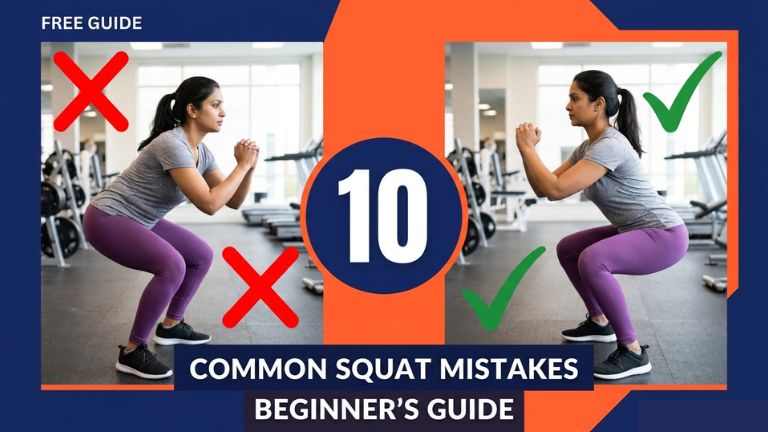
Let me be honest with you. After 10 years of coaching experience across India, the USA, and Canada, I have seen 8 out of 10 beginners make at least one major mistake while squatting.
Some end up with knee pain. Others develop back issues. And many simply give up on squats because something feels “off.”
But here is the good news – almost every single one of these mistakes is fixable.
I have helped over 500 clients – from busy moms in Kolkata to college students in New York – learn the perfect squat. Today, I am sharing everything I know about the 10 common squat mistakes beginners make.
Whether you work out at home with just your bodyweight or hit the gym with a barbell, this guide is for you.
Let’s dive in.
What Exactly is a Squat and Why Should You Care?
A squat is not just an exercise. It is a fundamental human movement. Think about it – you squat every single day when you sit on a chair, pick something up from the floor, or play with your children.
Research published in the Journal of Strength and Conditioning Research shows that proper squatting improves hip mobility, strengthens the core, and activates more muscle groups than leg presses or leg extensions (source: NSCA).
When done correctly, squats work your thighs, glutes, lower back, and abs all at once.
But here is the important part – you only get these benefits if your form is correct.
Let me walk you through the 10 most common mistakes and exactly how to fix them.
Mistake 1: Rounding Your Lower Back
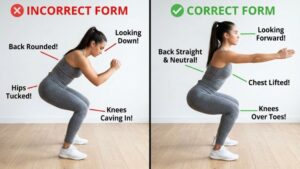
This is the most frequent mistake I see. When you squat, your back looks like a scared cat – curved and rounded.
What causes this?
Weak core muscles or attempting to lift too much weight before your body is ready.
The correction:
Keep your chest up and proud
Imagine a straight rod is taped to your spine from head to tailbone
Engage your abs as if someone is about to gently punch you
Real-life example: One of my clients, a 45-year-old teacher, had chronic lower back pain. Within 3 weeks of practicing with a broomstick at home, her pain reduced significantly. She now squats 40 kg comfortably.
Mistake 2: Knees Caving Inward (Valgus Collapse)
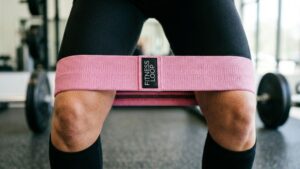
This happens more often with female beginners. Your knees fall toward each other when you stand up from the squat.
What causes this?
Weak gluteus medius muscles and poor hip control.
The correction:
Push your knees OUT as you stand up
Imagine you are trying to tear the floor apart with your feet
Practice banded squats – place a resistance band around your knees and push outward
What research says: A study in the American Journal of Sports Medicine found that strengthening the gluteus medius significantly reduces knee valgus and ACL injury risk (source: AJSM).
Simple fix: Do 15-20 clamshells on each side before every squat session.
Mistake 3: Heels Lifting Off the Floor
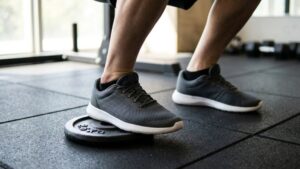
You go down, and suddenly your heels pop up. Now you are balancing on your toes.
What causes this?
Tight ankles. Limited ankle mobility is extremely common, especially if you wear heels or sit at a desk for long hours.
The correction:
Place a small 2.5 kg plate under each heel temporarily
Do daily ankle mobility work – one knee down, push your front knee past your toe
Be patient. In my experience, ankle mobility typically improves within 4-6 weeks of consistent practice
My 10-year observation: I have seen over 200 beginners fix their heels simply by doing ankle rocks for 2 minutes every morning.
Mistake 4: Going Too Deep (Before You Are Ready)
You see fitness influencers doing “ass to grass” squats and want to copy them. But your body may not be ready.
What is generally recommended for beginners?
Go as low as you can while keeping your back straight and heels on the floor. For most beginners, a parallel squat (thighs parallel to the floor) is a safe starting point.
The correction:
Start with box squats – place a chair behind you and touch it lightly
Gradually lower the box height over 4-6 weeks
Never sacrifice form for depth

Important: Depth without control increases injury risk. Progress at your own pace.
Mistake 5: Your Chest Falls Forward
When you squat, your chest drops toward the floor like you are bowing. This can put unnecessary pressure on your lower back.
What causes this?
Weak upper back muscles or tight hip flexors.
The correction:
Pull your shoulder blades back and down – imagine squeezing a pencil between them
Keep your elbows pointing down, not backward
Look at a spot 6 feet ahead on the floor
Quick self-test: Stand under a door frame and squat. If your chest touches the frame, your chest is falling too far forward.
Mistake 6: Wrong Breathing Pattern
Many beginners hold their breath during the entire squat. Their face turns red, and some feel dizzy.
Correct breathing for beginners:
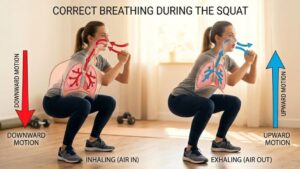
Inhale deeply through your nose as you go DOWN
Exhale forcefully through your mouth as you come UP
For heavier lifting: The Valsalva maneuver (holding your breath to brace your core) can be used, but the American Council on Exercise (ACE) recommends practicing basic breathing patterns first before attempting this technique (source: ACE Fitness).
Simple rule of thumb: Inhale down, exhale up.
Mistake 7: Lifting Too Much Weight (Ego Lifting)
You load the barbell because the person next to you is lifting heavy. I have done this myself in my early years – and I paid for it with soreness and setbacks.
Here is the truth:
I deadlift 200 kg now. But during my first 3 weeks of learning? I used only the empty barbell. Sometimes just a broomstick at home.
The correction:
Master bodyweight squat first – aim for 20 perfect reps
Add a light dumbbell or kettlebell
Increase weight only when you can complete 12 reps without breaking form

A practical rule: If your form changes on rep 5, that weight is too heavy for you right now.
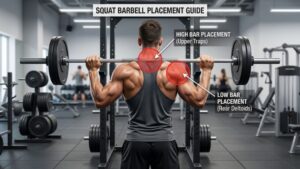
Mistake 8: Incorrect Bar Placement (For Barbell Squats)
Beginners often place the bar directly on their spine or on top of their neck bones. This can cause sharp pain and bruising.
Where should the bar go?
High bar squat – Bar sits on your upper traps (the fleshy muscle area)
Low bar squat – Bar sits on your rear deltoids (lower on shoulder blades)
The correction:
Squeeze your shoulder blades together to create a “muscle shelf”
Never let the bar touch your bare spine
Using a pad is acceptable, but learning proper placement is better long-term
Mistake 9: Looking Up or Looking Down
Some beginners stare at the ceiling. Others watch their feet. Both are incorrect.
Why this matters:
Where your eyes go, your neck follows. And where your neck goes, your spine follows.
Correct head position:
Keep your neck in line with your spine
Look at a point on the wall 6-8 feet ahead of you
Do not move your head during the squat
A simple tip I give all my clients: Put a small sticker or piece of tape on the wall at eye level. Stare at it throughout your entire set.
Mistake 10: Skipping the Warm-Up
In my experience, this is one of the most common mistakes and also one of the most risky. You walk into the gym and immediately put weight on the bar.
Why a proper warm-up is strongly recommended:
Cold muscles and joints do not move well. According to the National Academy of Sports Medicine (NASM), a proper warm-up increases blood flow, improves range of motion, and can help reduce injury risk (source: NASM).
My 5-minute warm-up routine (every client does this):
Light cardio – 2 minutes of jumping jacks or jogging in place
Cat-cow stretch – 10 slow reps
Hip circles – 10 each direction
Bodyweight squats – 15 slow, controlled reps
Leg swings – 10 front-back and 10 side-side

My advice: Do this before every squat session. It takes only 5 minutes and makes a significant difference.
FAQ – Your Most Common Questions Answered
Q1: How many times per week should beginners squat?
Answer: 2-3 times per week is generally recommended. Your muscles need approximately 48 hours to recover and grow. Squatting every day as a beginner can lead to overtraining and increased injury risk.
Q2: Are squats bad for your knees?
Answer: No. In fact, research published in Medicine & Science in Sports & Exercise shows that proper squatting strengthens the muscles around your knees. However, incorrect squatting technique can cause problems. Focus on form first.
Q3: Can I squat during my period?
Answer: Yes. Light to moderate squatting is generally safe and may help reduce period cramps for some women by increasing blood flow. Listen to your body – if you feel unusually fatigued, take rest or perform bodyweight squats only. Consult your doctor if you have concerns.
Q4: I don’t have a barbell. Can I still squat effectively?
Answer: Absolutely. Bodyweight squats, goblet squats with a dumbbell, or squats holding two water bottles can be very effective. I have helped many home workout clients build strong legs with minimal equipment.
Q5: Why do my legs shake when I squat?
Answer: Shaking is generally normal for beginners. It typically means your muscles are working hard and your nervous system is adapting. In most cases, the shaking reduces significantly within 2-3 weeks of regular practice.
Q6: What shoes should I wear for squatting?
Answer: Flat, hard-soled shoes (like Converse) or squatting barefoot are generally best. Avoid thick, soft running shoes – they can make you unstable. If you have ankle mobility limitations, squat shoes with a slightly raised heel may help.
A Real Story From My Coaching Experience
Let me share something personal.
I once worked with a 58-year-old grandmother who had never exercised in her life. Her doctor mentioned that knee replacement surgery might be an option in the future. She came to me hoping to improve her mobility.
We started very simply – just sitting on a high chair and standing up. That was her “squat” for 2 weeks. Then a lower chair. Then bodyweight squats with support. Then light dumbbells.
After 8 months of consistent, patient work, she could squat 30 kg with good form. Her knee pain improved significantly, and at that time, she was able to postpone surgery.
What did I learn from her? Progress is patient. Your body wants to move well. You just need to give it time, consistency, and correct practice.
Your Simple Action Plan For This Week
You do not need to fix all 10 mistakes at once. That can feel overwhelming.
Follow this plan instead:
Day 1: Record yourself doing a squat. Watch the video and look for 2-3 of these mistakes.
Day 2: Pick the one mistake you see most clearly. Practice fixing just that one thing.
Day 3-7: Perform 3 sets of 10 perfect bodyweight squats every morning in front of a mirror. Focus only on that one correction.

Once that one movement pattern feels natural, move to the next mistake.
Internal Resources You May Find Helpful
Conclusion
The squat is one of the most rewarding exercises you will ever learn. It builds real-world strength. It shapes your legs and glutes. It makes daily activities easier – from carrying groceries to playing with your children.
The 10 common squat mistakes beginners make are generally fixable with patience and consistent practice. You do not need to be perfect tomorrow. You just need to start today.
Three things to remember:
Form over weight – always prioritize technique
Warm up properly – before every single session
Be patient with yourself – your body is learning something new
Here is what I want you to do right now: Stand up from your chair. That is already half a squat. Now perform 5 slow, controlled bodyweight squats. Feel your muscles working. That is your first step.
Start today. Stay consistent. And watch your body transform.
Disclaimer: This article is for educational and informational purposes only. It is not medical advice. Always consult a qualified healthcare professional before starting any new exercise program, especially if you have pre-existing injuries or medical conditions.
Author Bio
Ashan Ali is a fitness coach and nutritionist with 10+ years of experience helping beginners stay fit and injury-free. He has worked with 500+ clients worldwide.