Let’s get started! Have you given up on building muscle because you don’t have time for the gym or can’t afford expensive memberships? The good news is you can gain muscle right from your home.
In my 10+ years as a certified fitness coach and nutritionist, I have helped hundreds of beginners, busy women, and office-going professionals build noticeable muscle using only bodyweight exercises and simple home nutrition. Many of my clients who live in small apartments or work long hours in busy cities like Delhi have achieved visible results with this approach.
Research shows that bodyweight training can effectively build muscle when done correctly. A 2023 study found that body mass-based resistance training can increase muscle cross-sectional area similar to traditional weight training, especially for beginners. According to Harvard Health, bodyweight exercises can build muscle without needing external loads.
This guide is made for real beginners — whether you are just starting, have a busy schedule, or simply prefer working out at home. You will find step-by-step exercises, a practical Indian-style diet plan, a ready-to-follow workout schedule, and real client stories. By the end, you will know exactly how to start and keep progressing safely.
Important Disclaimer: This guide is for educational purposes only. Before starting any new fitness program, consult your doctor or a qualified healthcare professional, especially if you have any pre-existing medical conditions.
Why Bodyweight Training Works for Building Muscle
Muscle growth happens when you challenge your muscles and then give them proper protein and rest to repair them stronger. Studies indicate that high-repetition bodyweight training taken close to failure can promote muscle hypertrophy much like lifting weights, particularly for beginners.
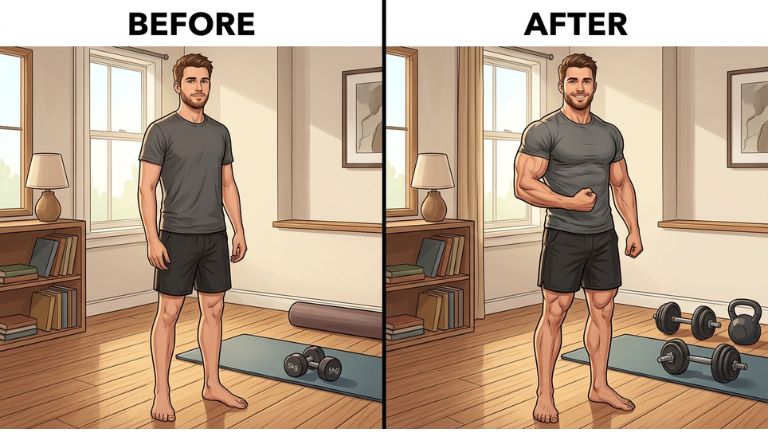
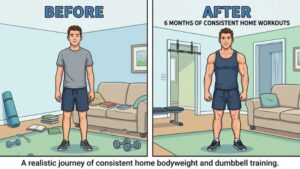
One of my clients, Priya, a 35-year-old busy mom from Mumbai, gained noticeable definition in her arms and chest within 8 weeks using push-up variations and consistent protein intake. Another client, a software engineer from Delhi, saw clear improvements in strength and muscle tone after 12 weeks of following this home routine.

The Science Behind Muscle Growth at Home
Muscle building requires three key elements: mechanical tension, muscle damage, and metabolic stress. Bodyweight exercises can provide all three when performed with proper form and progression.
According to a 2023 study published in the Journal of Strength and Conditioning Research, progressive bodyweight training can significantly increase muscle thickness in young adults. Another review emphasized that managing volume and intensity effectively during resistance training with body mass alone can lead to significant hypertrophy.
The good news is you do not need heavy weights. Your own body provides enough resistance to stimulate growth if you keep challenging yourself over time.
Best Bodyweight Exercises to Gain Muscle at Home
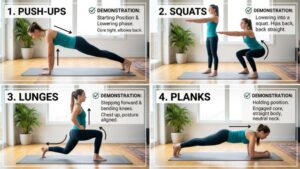
Here are the most effective exercises grouped by body part. Focus on controlled movements and good form.
Upper Body Exercises
- Push-ups: Targets chest, shoulders, and triceps. Start on your knees if needed and progress to full push-ups.
- Diamond push-ups: Places more emphasis on triceps.
- Pike push-ups: Excellent for building shoulders.
- Superman holds: Strengthens the back muscles.
Lower Body Exercises
- Bodyweight squats: Works quads, glutes, and hamstrings. Aim for 12–20 reps.
- Lunges (walking or reverse): Builds legs and improves balance.
- Glute bridges: Great for strengthening the backside.
- Calf raises can be progressed to a single-leg version.
Core and Full-Body Movements
- Plank: Hold for 20–60 seconds to build core stability.
- Mountain climbers: Engages the core while adding light cardio.
- Burpees (modified without jump if needed): Full-body strength and conditioning.
Practical Tip: Record yourself to check your form. Perform 3 sets of 8–15 repetitions for most exercises. Rest 60–90 seconds between sets. Always warm up with 5 minutes of light movement like arm circles or marching in place.
Nutrition for Muscle Gain: Easy Indian Home Diet Tips
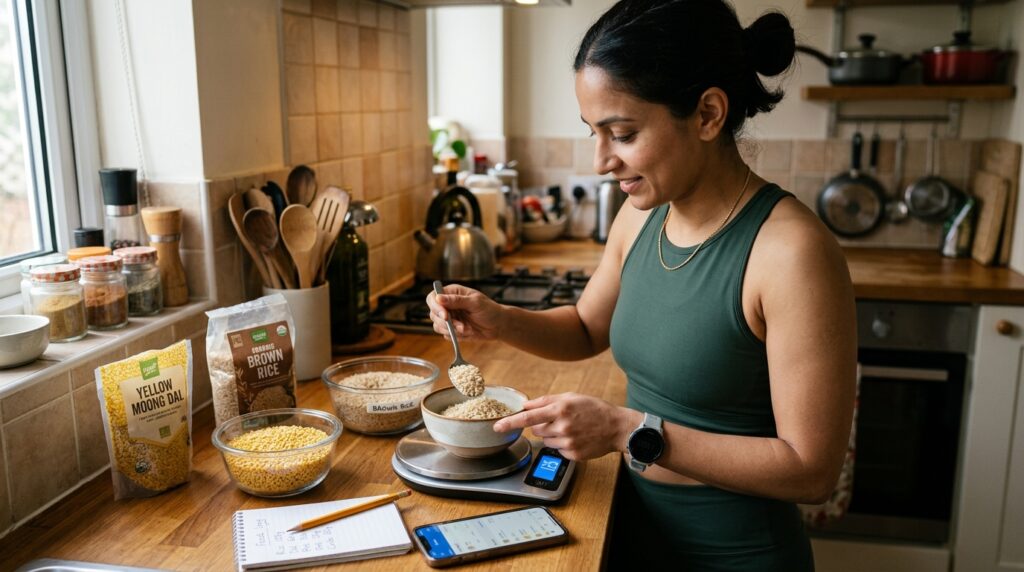
Exercise accounts for about 30% of results, while nutrition drives 70%. To build muscle, aim for a slight calorie surplus and 1.6–2.2 grams of protein per kilogram of body weight daily—a range supported by multiple research studies on resistance training.

For a 70 kg person, this means roughly 112–154 grams of protein per day.
Simple Daily Meal Ideas (Indian Household Friendly):
- Breakfast: 2 whole eggs with oats, milk, and a spoon of peanut butter.
- Lunch: Dal, rice, chicken or paneer sabzi, and plenty of vegetables.
- Mid-meal snack: Greek yogurt or roasted chana with a banana.
- Dinner: Roti, fish or mixed vegetables, and a side salad.
Studies, including meta-analyses on protein intake for muscle hypertrophy, confirm that combining resistance training with higher protein consumption helps increase lean body mass.
If you are vegetarian, rely on paneer, lentils, soy chunks, milk, and curd. Drink 3–4 liters of water daily and add healthy fats like ghee or nuts in moderation. Many of my clients successfully build muscle using regular home-cooked Indian meals without expensive supplements.

How to Use Progressive Overload Without Any Equipment
Progressive overload is the most important principle for continuous muscle growth. Research consistently shows that gradually increasing the challenge is what drives long-term progress.
Here are practical ways to progress at home:
- Increase the number of repetitions (e.g., from 10 to 15 push-ups).
- Slow down the movement (3 seconds lowering phase).
- Move to harder variations (knee push-ups → full push-ups → diamond push-ups).
- Add pauses at the most difficult point.
- Reduce rest time between sets.
- Try single-limb versions (one-leg squats or one-arm planks).
Track your workouts in a simple notebook or phone app. Every 2 weeks, make at least one exercise slightly harder. In my experience with clients, this approach often leads to 20–30% strength gains per month in the beginning.

4-Week Beginner Home Muscle-Building Plan
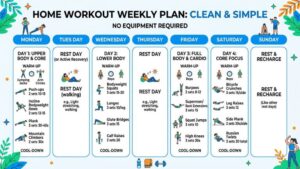
Training Frequency: 3–4 days per week (30–45 minutes per session)
Week 1–2 (Foundation Phase): Focus on learning proper form with easier variations.
- Monday: Upper body focus
- Wednesday: Lower body focus
- Friday: Full body + core
Week 3–4 (Progression Phase): Increase reps or move to more challenging versions of the same exercises.
Always include a 5-minute warm-up and end with stretching. On rest days, go for a light walk or do gentle mobility work. Sleep 7–9 hours every night—this is when your muscles actually recover and grow.
Common Mistakes to Avoid and Recovery Tips
Many beginners make these mistakes:
- Skipping enough protein in their meals
- Repeating the same workout without progression
- Training every day without rest
- Expecting dramatic changes in the first 2 weeks
For better recovery, prioritize sleep, manage stress through simple breathing exercises or meditation, and listen to your body. Taking weekly photos and body measurements helps you see progress even when the mirror doesn’t show it yet.
FAQ: Common Questions About Gaining Muscle Without a Gym
1. How long does it take to see results?

Most beginners notice improvements in strength within 4–6 weeks and visible muscle changes in 8–12 weeks with consistent effort.
2. Will women become bulky from this training?
No. Women naturally have lower testosterone levels, so you will develop a toned and strong physique rather than bulky muscles.
3. Do I need supplements?
Whole foods should come first. A protein powder can help only if you struggle to meet your protein target from regular meals.
4. Is this suitable for skinny or overweight beginners?
Yes. Skinny individuals should focus on a proper calorie surplus, while those carrying extra weight benefit from higher protein to preserve muscle during fat loss.
5. How many days per week should I train?

For beginners, 3–4 days per week is ideal and sustainable.
6. Is home training as effective as going to the gym?
For many busy people, home training is actually more effective long-term because it removes barriers and improves consistency.
Conclusion: Start Your Muscle-Building Journey Today
You now have a complete, practical, and science-supported roadmap to gain muscle without stepping into a gym. Everything in this guide is based on my 10+ years of real coaching experience and the successful results of hundreds of clients I have guided.
Consistency and patience are key. Start with today’s workout, focus on your nutrition, and track your progress. Small daily actions lead to big transformations over time.
Ready to begin? Do your first session today and feel the difference. Share your progress with us — we love celebrating every win with our readers.
For more helpful guides, check out the following:

Ashan Ali is a fitness coach and nutrition-focused content creator helping beginners achieve sustainable weight loss through simple home workouts and healthy recipes. With practical experience working with clients across India, he focuses on easy, real-life solutions that anyone can follow.
His approach is based on consistency, balanced nutrition, and beginner-friendly fitness routines designed for busy people. Through his content, he aims to make health and fitness simple, realistic, and effective for everyday life.