Important Disclaimer: This article is for educational and informational purposes only. It is not a substitute for professional medical advice. Always consult a qualified healthcare professional or registered dietitian before making significant changes to your diet or exercise routine, especially if you have any medical conditions.
Are you a complete beginner who wants to lose weight, build muscle, or simply feel healthier and more energetic? Learning how to count calories and macros can be one of the most effective tools to help you reach your goals sustainably.
In my 10+ years as a certified fitness coach and nutritionist, I have guided thousands of beginners, busy women, and working professionals worldwide—many training at home or in the gym—using this straightforward approach. From mothers in Guwahati to office workers across India and abroad, the clients who consistently applied these steps saw steady, healthy progress.
This guide breaks everything down into simple, actionable steps. No complex calculations or expensive programs are required to start. Research, including studies on dietary tracking, suggests that people who monitor their intake often achieve better and more consistent weight loss results compared to those who do not.
By the end of this article, you will feel confident to begin today. Let’s take it step by step together.

What Are Calories and Macros? Easy Explanation for Beginners
Calories are units of energy your body obtains from food. Your body uses this energy for daily activities, exercise, and even basic functions like breathing while you sleep.
Macros, or macronutrients, refer to the three primary components of food:
- Protein—helps build and repair muscles and keeps you feeling full
- Carbs (Carbohydrates) — provide energy, especially useful before workouts
- Fats support hormone health, brain function, skin, and hair
Each gram of protein or carbohydrates supplies about 4 calories, while each gram of fat supplies 9 calories.

Many of my clients initially believed that simply eating less was enough. However, without paying attention to macros, they sometimes lost muscle along with fat and felt low on energy. For example, Riya, a busy professional from Guwahati, lost 8 kg and regained her strength after learning to balance her macros properly.
Studies indicate that while reducing calories leads to weight loss, paying attention to macronutrient balance supports healthier, more sustainable outcomes.
Why Count Calories and Macros? Practical Benefits for Real Life
Tracking calories and macros helps you:
- Create a moderate calorie deficit for healthy weight loss
- Support muscle building with a slight surplus and adequate protein
- Maintain energy levels and overall well-being
In my experience working with busy people, those who track their intake tend to stay more motivated because they can observe their progress clearly. This method is especially practical for women and beginners with limited time.

Step 1: Calculate Your Daily Calorie Needs
First, determine approximately how many calories your body needs each day.
Calculate Your BMR (Basal Metabolic Rate)
The Mifflin-St Jeor equation is one of the most widely used and reliable formulas for estimating BMR.
For women: BMR = 10 × weight (kg) + 6.25 × height (cm) – 5 × age – 161 For men: BMR = 10 × weight (kg) + 6.25 × height (cm) – 5 × age + 5
Example: A 30-year-old woman weighing 60 kg and 160 cm tall has a BMR of approximately 1,349 calories.
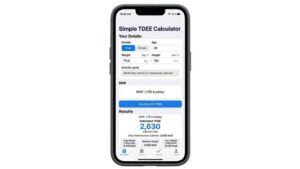
Calculate Your TDEE (Total Daily Energy Expenditure)
Multiply your BMR by an activity factor:
- Sedentary (desk job, minimal walking) → × 1.2
- Lightly active → × 1.375
- Moderately active (exercise 3–5 days) → × 1.55
- Very active → × 1.725
For weight loss, many people start by consuming 300–500 calories below their TDEE. For muscle gain, a small surplus is often used.
This approach is the same one I teach my clients, and they usually find it straightforward once they try it.
Step 2: Set Your Macro Targets
A common starting macro split for beginners focusing on fat loss is roughly the following:
- Protein: 30–35%
- Carbohydrates: 40–45%
- Fats: 25–30%
The International Society of Sports Nutrition suggests that active individuals may benefit from 1.4–2.0 g of protein per kg of body weight per day for muscle maintenance and growth.
Example on a 2,000-calorie diet:
- Protein: ~150g
- Carbs: ~200g
- Fats: ~67g
One of my clients, Priyanka (a 45-year-old mother), increased her protein intake and noticed reduced hunger while progressing toward her goals.
Step 3: How to Track Calories and Macros Daily
Recommended Free Apps
- MyFitnessPal — user-friendly with a large database of Indian foods
- Lose It! — quick barcode scanner
- Chronometer—detailed and accurate tracking
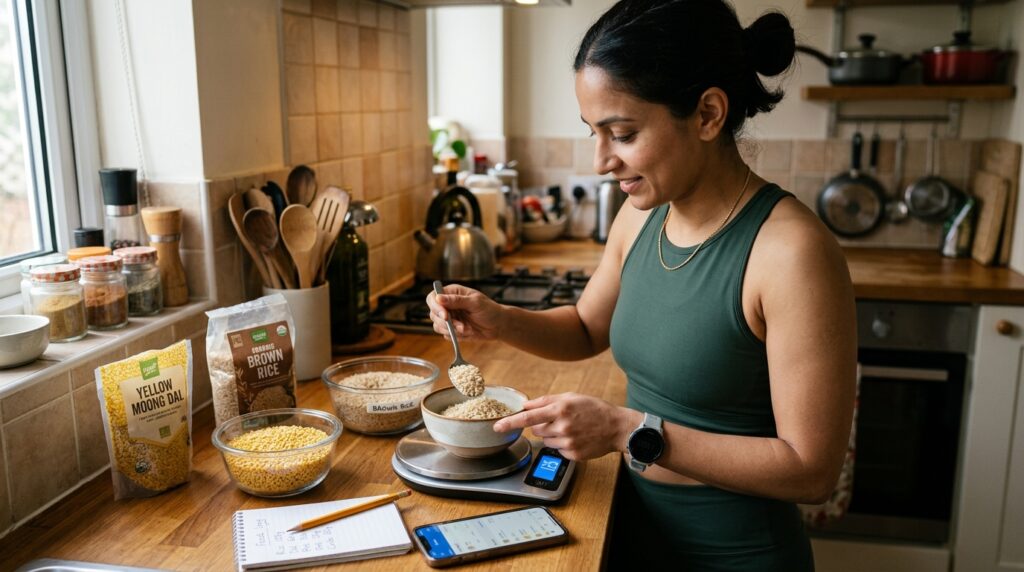
Weigh your food with a simple kitchen scale for better accuracy, especially in the beginning.
Pro tip: During the first week, focus only on logging your current meals without changing anything. This awareness alone often leads to better choices naturally.

Step 4: Practical Tips for Indian Homes and Busy Lifestyles
Indian meals are easy to track once you know approximate values:
- 1 bowl of cooked rice ≈ 45g carbs
- 1 bowl of dal ≈ 15g protein
- 100g chicken or fish ≈ 25g protein
Helpful habits for busy schedules:
- Snap a quick photo of your plate and log it later
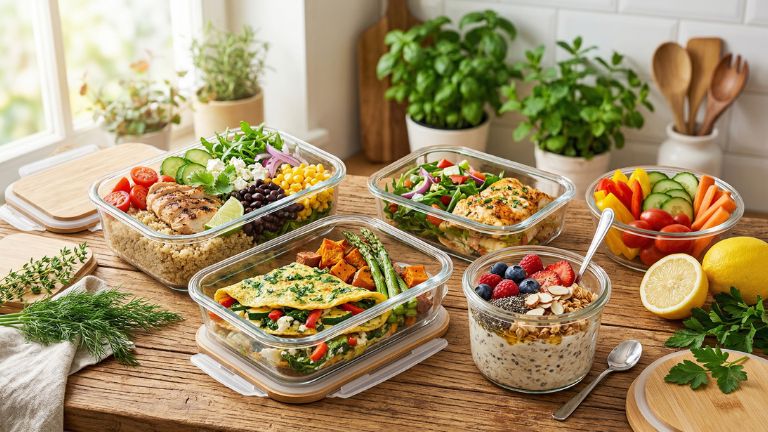
- Meal prep on weekends
- Follow the 80/20 rule—track strictly most of the time while allowing flexibility for social occasions
For more ideas on increasing daily movement, check our Beginner Home Workout Plan.
Common Mistakes and How to Avoid Them
- Focusing only on calories while ignoring macros
- Being too strict and getting bored quickly
- Expecting dramatic results in the first two weeks
- Underestimating portion sizes
Review your weight, measurements, and photos every 2–3 weeks and make small adjustments as needed.
FAQ – Common Questions Answered
1. Can I track without an app?
Yes. Use a notebook and simple Google searches for food values.
2. What macro ratio works well for Indian women aiming to lose belly fat?
Many start successfully with higher protein (around 30–35%) and moderate carbs and fats. Listen to your body and adjust.
3. Do I need to track forever?
No. After a few months, most people develop a good sense of portions and track only occasionally.
4. Is this suitable for vegetarians?
Yes. Paneer, curd, lentils, soya chunks, and chickpeas are excellent options. Many of my vegetarian clients have achieved great results.
5. What about eating out?
Estimate using the app or make a reasonable guess and balance it the next day.
6. When will I see results?
Many notice better energy within 2–4 weeks. Visible changes often appear in 6–8 weeks with consistent effort.

Conclusion: Start Your Journey Today
Counting calories and macros is about building awareness and making consistent, realistic choices — not about being perfect.
Take the first step today: Calculate your needs, download a free app, and log one meal. With patience and consistency, you can achieve meaningful, lasting results.
You are not alone on this journey. Share your questions or progress in the comments — I’m here to support you.
For a more personalized approach, explore our Custom Meal Plan Guide.
Stay consistent and be kind to yourself. You’ve got this! 💪
Medical Disclaimer: The information provided here is educational. It does not replace personalized advice from a doctor or registered dietitian. Results vary from person to person.

Ashan Ali is a fitness coach and nutrition-focused content creator helping beginners achieve sustainable weight loss through simple home workouts and healthy recipes. With practical experience working with clients across India, he focuses on easy, real-life solutions that anyone can follow.
His approach is based on consistency, balanced nutrition, and beginner-friendly fitness routines designed for busy people. Through his content, he aims to make health and fitness simple, realistic, and effective for everyday life.